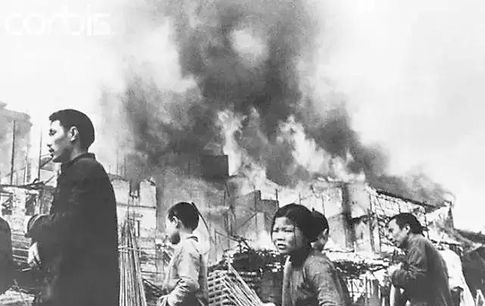
That night my son died in my arms. He was just three years old. He was born during a Japanese bombing raid and died in another one. His three years of short life were full of memories of air-raid sirens, running for shelters, and being hungry and thirsty.
—Cui Xiangyu, a doctor’s wife, born in 1918 in Yichang, Hubei Province
那天晚上,我儿子死在了我的怀里,他才三岁大啊。他在日军轰炸警报中出生,又在另一个警报中死去。在他对这个世界短短三年的记忆里,全是空袭警报,往防空洞奔跑,忍饥挨饿。
—崔香玉,医生的太太,1918年生于湖北宜昌
Info link
Conditions in public shelters
Compared to eastern regions, Chongqing was better-endowed for sheltering air bombs, mainly because of its topography. However, considering the intensity of the air raids, Chongqing’s shelters had three major issues:
1) the shelters’ sizes did not correlate to the population density,
2) they were rarely as deep or had entrances as wide as needed, and
3) they lacked the funds to provide adequate food or equipment.
The shelters existed in states of perpetual destruction. Thus, though bombs were dropped fairly evenly in the geographical sense, the lower and middle classes that suffered disproportionately. Organisations with abundant funds tended to build better-equipped shelters for their employees, while others had to rely on public shelters, which suffered from insufficient funds, administrative overlap, and a rapid increase in demand due to the mass influx of people nationwide.
As a result, public shelters often lacked proper ceilings and flooring, lighting, medical supplies, or ventilation facilities. This meant that the majority of people in the city had to frequently stay in crowded, unfurnished caves for hours or days, anytime the sirens went off, without knowing when they could get out. There was nowhere to cook in the public shelters, and many couldn’t afford packaged food, so people would often have to go days without food. After the war, many suffered PTSD from siren sounds.