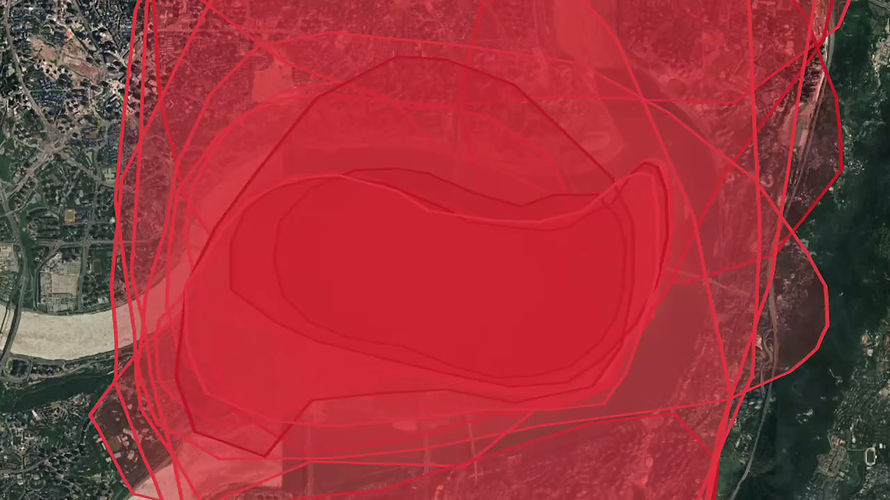
Map of Recorded Bombings
Feb 1938 - Aug 1943
According to: An Account of Chongqing's Air Defense (Southwest Normal University Press) -Chronicles
重庆市防空志(西南师范大学出版社)-大事记
Chongqing, the Wartime Capital
Protection Amidst Mountains
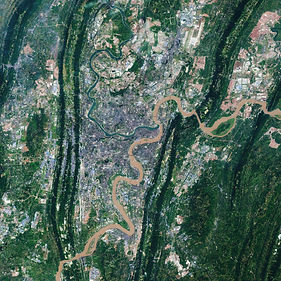
Chongqing sits at the confluence of the Yangtze and Jialing Rivers. It is a city shaped by rugged mountains and deep gorges. This topography protected against aerial attacks, and provided natural sites for air raid tunnels.
Existing Transportation Linkages
Chongqing had pre-existing transportation links with eastern parts of China, which allowed relatively easy and quick migration of people and machineries.
The National Government Relocation on October 30, 1937
As Shanghai fell and Nanjing came under threat, the National Government began relocating to Chongqing on October 30, 1937, with a formal declaration following on November 20. The move was framed as strategic repositioning — trading space for time — rather than retreat. Chongqing became the temporary political and military centre of China for the duration of the war.

Carpet Bombing
Force Surrender
Japan aimed to force the National Government into surrender by making Chongqing unliveable for its residents and ungovernable for the government. Japan used air raids to destroy Chongqing's infrastructure, supply networks, and economic sectors.
Terrorising Civilians and Devastating Morale
Japan shifted strategy from targeted attacks to mass terror. Carpet bombing (also known as saturation bombing) indiscriminately attacked areas of the city, and often even deliberately targeting civilians, in order to maximise casualties and paralyse the city.
Most Cost-effective Option of Genocide
Chongqing's rugged topography protected itself from ground assault and precision bombing. For the Japanese army, carpet bombing became the most efficiently destructive solution, where Japanese aircrafts can inflict maximum destruction without requiring pinpoint accuracy.
Deaths and Destructions

*
*Many attacks and destructions could not be counted. The statistics for attacks that occurred in Chongqing city could often be uncertain, and attacks that occurred in the larger Chongqing region and Sichuan and Yunnan Provinces were not counted in the governmental document. Scholarly accounts after the 2000s put the estimated number of killed persons to 19,466 - 23,600, and wounded persons to 22,427 - 31,000.
Between February 18, 1938 and August 24, 1943, a total of 9,166 aircrafts were sent to attack Chongqing, dropping 15,122 high-explosive bombs and 2,690 incendiary bombs. As a result, 11,148 people were killed, 12,856 seriously wounded, as well as 17,542 buildings and 37,182 rooms of housing destroyed.

†
†Dotted lines are estimated numbers from scholarly accounts
For more detailed text-version accounts please see:
Information from Chongqingshifangkongzhi (Chongqing Air Defence Annuals, 重庆市防空志), edited by Li Zhiyong and compiled under the organization of the Chongqing Municipal Civil Air Defence Office