I walked, in person, through the suffocating tunnel that caused death to thousands of people. The tunnel only has one entry and no exit. Even in the 1950s when we were visiting the tunnels, it was still dark and suffocating inside. The air was terrible. The tunnel was very long, and the farther inside you went, the thinner the air was. Deep into the tunnel, even I felt it was difficult to breathe. I can totally imagine why, back then, people in the tunnel would cram towards outside, and why those horrible accidents would happen.
—Jin Zhongheng, student, born in 1925 in Chongqing Province
我亲自走过闷死了几千人的隧道。隧道只有一个进口,没有出口,就是在20世纪50年代我们参观隧道时,里面还是又黑又闷,空气不好。隧道很长,越往里走,氧气越稀薄。走进隧道深处,我都感觉到呼吸困难。我完全可以想象在隧道里面的人为什么要朝外面挤,惨案为什么会发生。
—金中恒,女学生,1925年生于重庆
Info link
The Massacre of May 3rd and May 4th, 1939,
and the Great Tunnel Massacre of June 5th, 1941
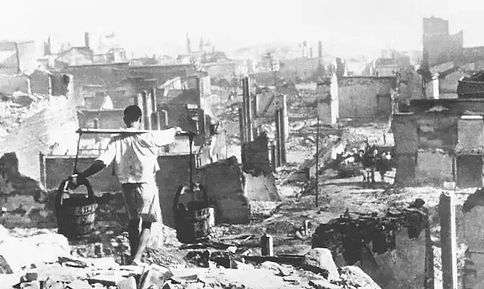
After the fall of Nanjing, Chongqing became China’s temporary capital and a major target for Japanese attacks. Instead of targeting industrial infrastructure and hospitals, the Japanese army took a carpet-bombing approach, where the goal was to inflict damage in every part of a selected areas of land, many of which were deliberately civilian zones. In Chongqing, this meant tens of thousands of bombs dropped, almost daily, for five years’ time.
Within this, the attacks on May 3rd and May 4th, 1939 stood out in its severity. After extended, intense bombing over Chongqing’s most populated areas, nearly 4,000 people died, fire ravaged the city, and around 200,000 people were left homeless.
On June 5th, 1941, Japanese warplanes launched a five-hour carpet bombing raid over Chongqing. Tens of thousands of residents rushed into public shelters near Jiaochangkou, Shibati, and Shihuishi. In a combination of prolonged sealing of tunnel entrances, overcrowding and no ventilation, as the air supply depleted, between 2,500 to 4,000 people died from suffocation, stampede, or heat.