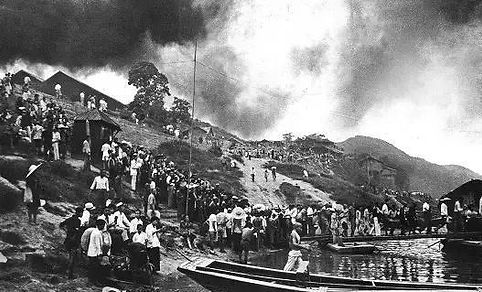
After the Battle of Shanghai, lots of Shanghai residents were trying to leave the city, and tickets for cars or boats were incredibly scarce. We only got to flee from Shanghai to Suzhou by paying a lot of money for car tickets. But soon after we arrived at Suzhou, it was attacked by the Japanese military. Again, we had to pay a lot of money to rent a car and fled to Nanjing. Who would have known that the Japanese followed us again towards Nanjing. We had to flee again to Wuhan. It was such a frantic rush. It was like the Japanese army was following us wherever we went.
—He Peihua, daughter-in-law of the president of Chongqing’s Chamber of Commerce, born in Chongqing in 1915
八一三淞沪会战打响后,很多在沪人士都想方设法离开上海,车船票都难得一求。我们是以重金购得车位,全家才得以逃离上海到苏州。但是我们刚到苏州不久,日本人就打过来了。我们又花重金雇车接着往南京跑。谁知日本人又跟着我们朝南京逼近。我们只得又逃离南京到武汉。一路仓皇,好像是我们走到哪里,日本人就打到哪里。
—何佩华,重庆商会会长的儿媳妇,1915年生于重庆
Info link
Expansion of Japanese air raids in China
Following the Marco Polo Bridge incident in July 1937, the Japanese Army Air Service launched aerial bombings against major cities including Nanjing, Shanghai and Guangzhou, targeting power plants, railways and other industrial infrastructure, resulting in mass civilian casualties.
However, after the fall of Nanjing and Chongqing became the wartime capital of the Chinese Nationalist government, the Japanese Army air raids took a carpet-bombing strategy and aimed at not only to destroy most infrastructure but also to wear down civilian morale.
The bombing started in downtown Chongqing but quickly expanded to suburbs and the larger Sichuan province. Between February 1938 and August 1943, an estimated 17,812 bombs were dropped in Chongqing by the Japanese army, destroying at least 54,634 homes, killing 11,148 persons and seriously injuring 12,856.